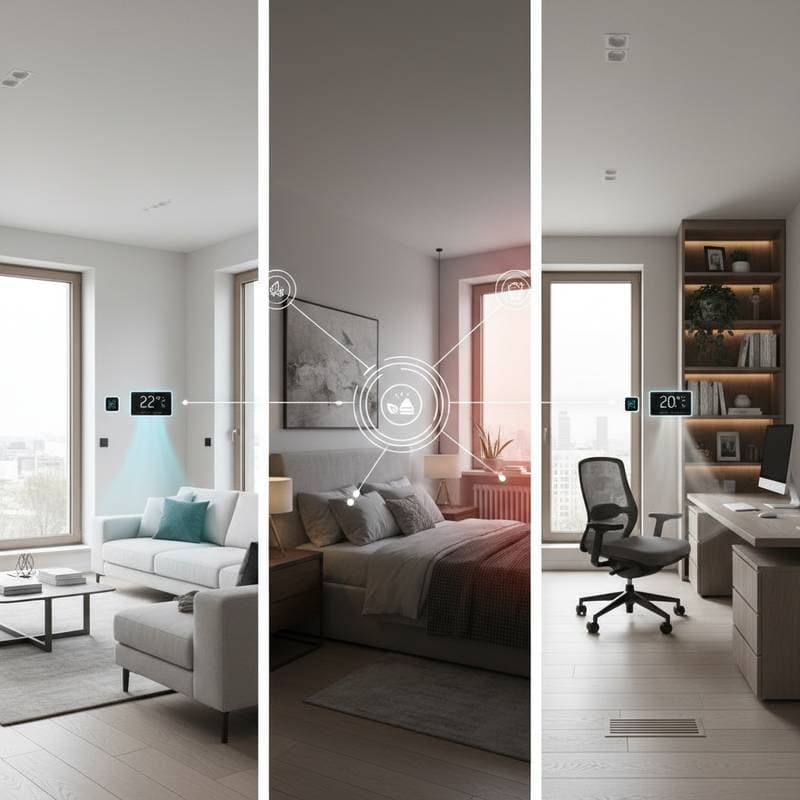
The Comfort Revolution: Why Personalized Zones Outperform Single Thermostats
Imagine entering your living room after dinner. The air feels crisp and inviting, precisely as preferred, yet a partner favors a warmer bedroom for evening reading. In a standard setup, a single thermostat attempts to accommodate all, which seldom succeeds. One person reaches for a blanket while another opens a window. This ongoing temperature conflict creates discomfort, wastes energy, and increases expenses.
Personalized climate zones change this dynamic. Rather than a central control setting conditions house-wide, these systems enable each room or area to sustain its optimal temperature. The impact proves immediate and significant. Homeowners gain enhanced comfort, better energy management, and prolonged HVAC system durability.
Limitations of a Uniform Thermostat Approach
A lone thermostat presumes uniform behavior across the home. However, variations in sunlight, insulation, room dimensions, and usage patterns render this assumption flawed. An upstairs bedroom may retain heat throughout the day, whereas a basement remains chilled regardless of settings. Efforts to balance via one device often lead to excess operation, conditioning the entire structure when only select areas require attention.
Such inefficiency intensifies in expansive homes or those with open designs. HVAC units operate beyond necessity, elevating utility costs. Prolonged runtime accelerates component degradation. Initial minor annoyances evolve into substantial repair expenses.
How Zoned Systems Address These Issues
Zoned heating and cooling segments the home into distinct areas, each governed by independent controls. Zones range from full floors to specific rooms. Electronic dampers within ducts adjust based on current readings, channeling air solely to demanding locations.
Contemporary setups employ intelligent thermostats or sensors for ongoing monitoring. The system conditions active spaces exclusively, avoiding whole-house efforts. Comfort becomes seamless: warmth envelops the living room during film viewing, while unused areas stay neutral and efficient.
Implementing a Zoned Climate Solution
Establishing zones varies by home configuration and current infrastructure.
-
Incorporate Smart Room Sensors with Current Thermostats
Devices like the ecobee Smart Thermostat Premium, priced at approximately $250, pair with remote sensors ($80 for a two-pack). These detect presence and temperature, equalizing conditions across rooms. This upgrade enhances satisfaction without duct modifications. -
Deploy a Multi-Zone Control Panel
Options such as the Honeywell Home HZ432 TrueZONE Panel, around $200, connect to existing HVAC. Professionals install dampers in ducts and zone-specific thermostats. This method suits larger residences or renovations, providing exact regulation. -
Select Ductless Mini-Split Configurations
For non-central systems, Mitsubishi Electric M-Series units (from $1,200 per indoor head) offer per-room operation. Independent indoor units afford versatility, excelling in extensions, garages, or adapted spaces.
Budgeting and Installation Timelines
Zoned HVAC expenses scale with project scope. Sensor additions to a thermostat total under $400, with installation in hours. Comprehensive retrofits involving dampers and wiring span $2,000 to $5,000, based on zone count. Ductless installations range $4,000 to $10,000, influenced by units and connections.
Experts advise professional involvement. Thermostat swaps suit capable individuals, but duct or electrical alterations demand skill to prevent imbalances. Certified technicians provide complimentary assessments; platforms like XavageTech HomeMatch facilitate swift professional comparisons.
Essential Preparation: Airflow Optimization
Prior to zoning, inspect ducts. Many attribute issues to equipment when restrictions or leaks cause problems. Sealing and balancing often yield marked improvements. Duct adjustments alone have reduced energy demands by 15 percent in documented instances. A solid base amplifies zoning benefits.
Core Technologies in Zoned Systems
Advanced zoning combines sensors, algorithms, and automated dampers. Systems adapt to routines, prioritizing zones by time and activity. Mornings focus on the kitchen, evenings on the living room, with automatic shifts.
Innovations like Flair Smart Vents ($90 each) employ wireless sensors to modulate standard vents. They direct flow accurately, suiting older homes averse to duct changes.
Integration and Compatibility Factors
Select solutions aligning with present HVAC and smart ecosystems. Many thermostats support Matter and Wi-Fi, integrating with Alexa or Google Home. Models including ecobee Premium, Nest Learning Thermostat, and Honeywell T9 ensure broad compatibility.
Opt for expandable designs to accommodate future growth. Scalability avoids full replacements. Mobile apps enable remote oversight of consumption and efficiency.
Efficiency and Sustainability Gains
Beyond comfort, zones elevate energy use. Conditioning occupied areas shortens runtime. Department of Energy research indicates up to 30 percent savings in average homes, equating to yearly hundreds in reduced costs.
Environmentally, diminished consumption lowers emissions. Each conserved kilowatt-hour shrinks the carbon impact. This choice benefits finances and ecology alike.
Enhanced Durability and Reduced Noise
Zoning lessens HVAC stress, extending component life. Fewer cycles spare compressors, blowers, and exchangers. Routine maintenance persists, but breakdowns decline.
Additionally, targeted operation quiets the home. Partial activation runs units at moderated speeds, eliminating persistent air whooshes.
Tailored System Recommendations by Budget
Affordable Choice:
ecobee Smart Thermostat Enhanced with sensors, about $200. Suits compact homes entering smart control.
Balanced Selection:
Nest Learning Thermostat with sensors, roughly $300. Features learning capabilities and multi-platform ties.
High-End Investment:
Mitsubishi M-Series Multi-Zone Mini-Split, from $5,000 installed. Delivers supreme adaptability and silent performance.
These integrate into smart networks and scale as needed. Align choices with home layout and preferences.
Steps to Achieve Zoned Comfort
Transitioning to zones begins with pinpointing problematic areas. Identify consistently uncomfortable rooms. Determine if sensors suffice or if full zoning applies. Engage a certified technician for duct evaluation and zone planning.
Post-installation, refine settings. Thermostats adapt over days, optimizing flow and schedules. Consistent temperatures, decreased bills, and intuitive environments emerge promptly.
Control empowers: customize spaces for cooking coolness or bedtime warmth. Zones represent essential evolution in residential climate management. With rising costs and accessible tech, this upgrade promises enduring efficiency and satisfaction.
Frequently Asked Questions
What distinguishes whole-home thermostats from zoned systems?
Whole-home units regulate from one point, whereas zoned setups segment the house for autonomous area controls.
Is zoning feasible with current HVAC?
Yes, ducted systems accommodate dampers and panels via retrofit. Inspections confirm suitability.
Do zoned systems necessitate unique thermostats?
They require compatible smart models or controllers. Verify matches prior to acquisition.
How many zones fit a typical home?
Layout dictates; two to four often suffice, covering living, sleeping, and lower levels.
Does zoning raise energy costs?
No, it curtails runtime by targeting used spaces, lowering overall use.
Can zones be managed remotely?
Yes, apps on smart thermostats and systems permit distant adjustments and views.
What is the installation duration?
Sensor setups finish in hours; complete zoning spans one to two days.
Is expert installation mandatory?
Yes, for optimal function and safety, particularly with ducts or wiring.