Touchless Faucets Reduce Kitchen Water Waste by 50%
Smart kitchens reshape daily activities such as cooking, cleaning, and resource management. Among the most effective innovations driving this transformation stands the touchless faucet. Originally a feature in commercial settings, this technology now serves as an accessible enhancement for connected residences. These motion-activated devices offer modern aesthetics and ease of use while enabling households to decrease water consumption by up to 50 percent. Homeowners achieve substantial annual savings in water volume without altering established routines.
Prioritizing Water Efficiency in Daily Routines
Water conservation emerges as a key element in contemporary smart home strategies. Research indicates that almost 50 percent of individuals purchasing new smart appliances prioritize environmental sustainability. In the kitchen, where tasks like food preparation, dishwashing, and hand cleaning occur frequently, minimizing waste proves essential. Conventional faucets demand manual operation, which frequently results in prolonged water flow beyond necessity. Brief periods of excess running during vegetable rinsing or dish scrubbing accumulate into significant daily totals.
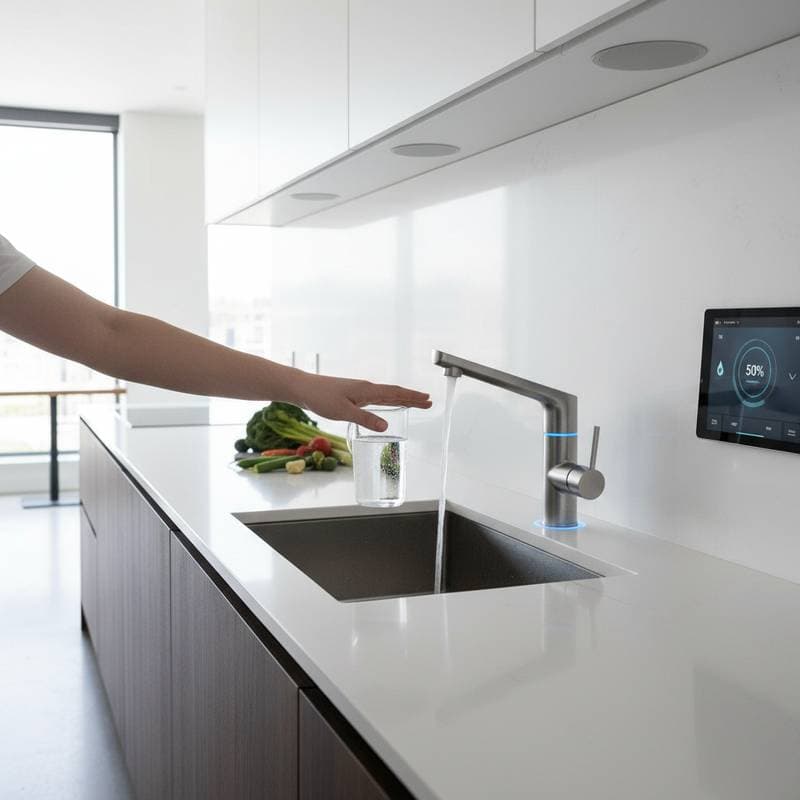
Touchless faucets address this issue through automated activation. Infrared or capacitive sensors detect hand movements or nearby objects, prompting water release only upon need. The flow ceases promptly once the sensor registers absence. This mechanism integrates seamlessly into everyday activities, promoting conservation without deliberate effort.
Mechanics of Touchless Faucet Operation
Touchless faucets employ infrared or capacitive sensors to identify motion. Positioning hands or items beneath the spout activates an internal valve, initiating water flow. Withdrawing the hands halts the stream without delay. Numerous models incorporate preset temperature settings or manual overrides to provide precise regulation.
Advanced configurations connect to smart home networks, supporting voice commands via digital assistants or remote modifications through applications. Envision issuing a verbal instruction to commence water flow while managing a pot during pasta preparation, or requesting temperature adjustments from a smart speaker amid dough handling. Such capabilities streamline kitchen operations, enhancing both sanitation and productivity.
Environmental and Economic Advantages for Households
Each conserved drop yields benefits for the planet and personal finances. Data from water management organizations reveal that motion-activated faucets lower kitchen water usage by as much as 50 percent. This reduction eases pressure on municipal supplies and diminishes utility expenses. For those pursuing eco-friendly living, implementing such a device represents a straightforward initial step.
Conservation efforts extend beyond faucets to align with wider practices. Many residences incorporate devices like programmable thermostats and energy-efficient bulbs. Touchless faucets complement this approach by applying targeted control to a routine essential, fostering overall precision in resource utilization.
Enhancing Hygiene in Kitchen Environments
Touchless faucets deliver advantages surpassing water savings through improved cleanliness. In active kitchens, risks of bacterial transfer arise from shared surfaces involving raw ingredients and utensils. Standard faucet handles accumulate microbes rapidly, particularly from contact with unclean hands. These systems bypass physical interaction entirely, minimizing contamination opportunities.
This attribute appeals strongly to health-conscious families, including those with young children or older adults. Fewer contact surfaces curb germ dissemination, yielding a more sanitary preparation area. Select premium variants feature antimicrobial coatings or aerators that clean themselves, bolstering protective measures.
Seamless Connections Within Smart Home Networks
Current touchless faucets interface effortlessly with central smart home controllers. Such linkages enable tracking of water consumption, analysis of usage patterns, or notifications about potential issues via smartphone applications. A linked faucet, for instance, alerts users to extended run times or minor leaks, averting expensive damages.
Compatibility extends to integrated systems encompassing appliances, illumination, and audio devices. Picture initiating a post-meal cleanup sequence: a spoken directive activates the faucet, dims lights appropriately, and queues preferred music. This orchestration renders the kitchen an adaptive space responsive to user behaviors.
Practical Illustrations from Leading Manufacturers
Prominent companies deliver touchless solutions tailored for residential use. Moen MotionSense faucets utilize dual sensors for accurate activation. Delta Touch2O variants merge sensor-based and surface-touch operations, accommodating diverse needs. Kohler models sync with voice-enabled systems, permitting control through speech or gestures. These developments redefine engagement with a core household element.
Market feedback underscores robust adoption. Sales figures from distributors indicate consistent increases, fueled by demands for usability and eco-responsibility. This pattern signals evolving expectations: consumers seek innovations that elevate routines while curbing resource depletion.
Addressing Affordability and Setup Challenges
Historically, touchless faucets commanded elevated prices, with installation posing hurdles for some. Market dynamics shift toward accessibility. Basic units now match the cost of superior manual alternatives, and designs facilitate self-installation without professional aid.
Battery-operated models eliminate electrical modifications, while rechargeable batteries minimize upkeep. For users with existing automation setups, incorporating a faucet involves straightforward device synchronization. Balancing cost-effectiveness, user-friendliness, and tangible returns renders the choice compelling.
Illustrative Daily Applications
Examine a typical morning sequence. Filling a coffee maker, washing produce, and cleaning hands involve multiple activations. A manual faucet permits water to continue flowing during retrieval of accessories. In contrast, a touchless version terminates flow automatically, conserving resources across instances.
Meal preparation benefits similarly. Rinse produce using one hand while gripping a utensil, avoiding handle contact. Post-cooking, activate flow with a gesture despite soiled hands. These efficiencies cultivate streamlined processes.
In family settings, touchless faucets aid younger users prone to oversight. Children engage without fully closing taps, yet the device manages shutoff. Across shared households, these efficiencies compound into notable monthly reductions.
Advancements in Intelligent Water Systems
Touchless technology forms a foundation for expansive water oversight innovations. Developers explore sensors for instantaneous quality assessment or whole-home usage monitoring. Future interfaces may supply customized efficiency summaries, akin to power consumption displays.
Kitchens evolve into dynamic zones, modulating flows based on detected activities. Merging sensors, analytics, and interoperability elevates conservation, preserving user satisfaction amid optimization.
Integrating Efficiency into Routine Practices
Touchless faucets exemplify how design merges usability, sanitation, and resource stewardship. No behavioral overhauls or intricate configurations prove necessary; adoption hinges on embracing refined functionality.
Assess personal patterns. Note instances of unattended water flow during multitasking or handle contacts amid preparation. A sensor-equipped faucet halves such inefficiencies, curbs microbial risks, and refines interactions. Progressive residences anticipate requirements while safeguarding assets, with these devices exemplifying that principle. Conservation emerges not as restriction, but enhancement.