Introduction to Smart Home Automation
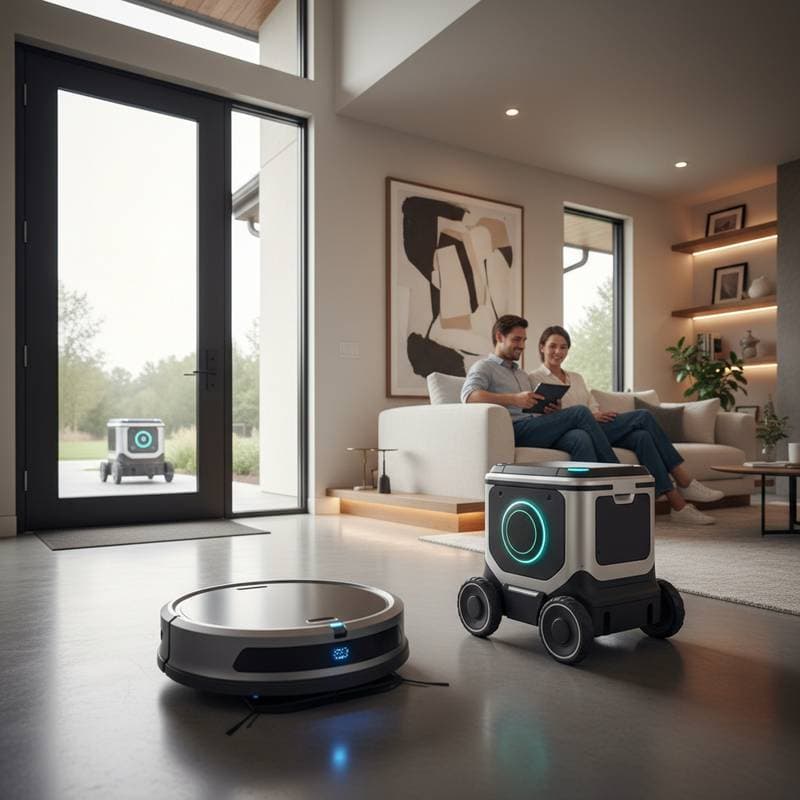
Picture returning home after a demanding day, removing your shoes, and observing your floors gain a fresh shine as a compact robot navigates the space effortlessly. Moments later, a delivery unit arrives at your entrance with your requested meal. This scenario, once confined to imagination, now occurs in residences nationwide. Smart robots have evolved from conceptual designs into reliable, cost-effective assistants that redefine cleaning and delivery processes.
Addressing Common Household Challenges
Maintaining a pristine home and managing errands demands significant time each week. Vacuuming one day and mopping the next often fails to eliminate dust or pet hair from hard-to-reach areas. Incorporating trips for groceries or packages intensifies this ongoing routine. Even individuals who appreciate organization recognize the endless nature of these duties. Advanced home robots intervene by managing these recurring, labor-intensive activities, allowing focus on more meaningful pursuits.
Evolution of Robotic Capabilities
Contemporary home robots integrate sophisticated sensors, integrated cameras, and adaptive algorithms to chart environments and avoid barriers. These systems surpass basic automated devices. Numerous models feature self-emptying compartments, automated fluid replenishment, and synchronization with additional home automation tools. Delivery units, in parallel, traverse limited routes, identify locations accurately, and notify users through applications upon arrival.
Their integration into routines proves effortless. Individuals seeking immaculate spaces or contactless provisions discover these robots designed for operation with limited oversight.
Exploring Available Solutions
Cleaning Robot Categories
For those initiating with sanitation tasks, options divide into vacuum-only units, dedicated mopping devices, and combined systems.
- Entry-Level Option: The Eufy RoboVac 11S, priced near $200, operates quietly and fits under furniture, suiting compact living areas. Lacking room mapping, it relies on infrared detection to prevent collisions with objects.
- Intermediate Selection: The Roborock Q Revo, at approximately $900, provides robust performance across vacuuming and mopping functions, with an auto-emptying dock. LiDAR technology ensures accurate pathfinding.
- High-End Model: The iRobot Roomba Combo j9+, costing about $1,400, advances independence through mop elevation mechanisms, targeted debris recognition, and compatibility with voice controls.
Practical advice: In homes with varied surfaces, select units offering variable suction and mop elevation to avoid moisture on textiles and preserve flooring integrity.
Delivery Robot Innovations
Autonomous delivery systems extend beyond experimental phases into broader applications. Units such as the Serve Robotics rover or Starship Technologies model transport essentials weighing several pounds via sidewalks, employing GPS and visual processing for secure travel.
Consumer-oriented variants facilitate operations between residences or within secured zones. Acquisition costs range from $1,000 to $2,500 for accessible models. Application-based interfaces enable planning, monitoring, and protected exchanges using electronic mechanisms.
Practical advice: Optimal performance requires stable wireless networks. In regions with signal inconsistencies, install supplementary outdoor connectivity to support navigation along entryways.
Installation and Upkeep Essentials
Initial configuration for cleaning robots typically requires one hour, encompassing application linkage and preliminary space scanning. Remove obstacles and cables prior to activation, permitting the device to familiarize itself with the arrangement. Performance enhances over subsequent uses as path optimization occurs autonomously.
Delivery robot preparation varies by design. Certain models necessitate a charging base adjacent to access points. Others utilize simple pads and application connectivity. Both categories demand periodic firmware enhancements for sustained functionality and protection.
Maintenance remains straightforward. Replace components like brushes, filters, and cleaning pads quarterly. Auto-discharging stations minimize allergen contact, benefiting sensitive individuals.
Financial Aspects and Sustained Benefits
Entry-level cleaning robots begin at $150, ascending to $1,500 for sophisticated variants. Delivery systems, though nascent, decrease in cost with growing popularity. True worth emerges in reclaimed time; a device reclaiming thirty minutes daily equates to over three days monthly.
Power consumption stays modest, under 100 watts during recharge, comparable to standard lighting. Annual electricity costs add mere dollars, offset by consistent sanitation.
Security and Dependability Factors
Confirm robots employ approved adapters and adhere to local power regulations. Supervise mopping operations on sensitive surfaces to prevent moisture damage. Delivery systems should incorporate boundary restrictions and data safeguards.
For intricate installations involving cabling or synchronization, engage qualified specialists via dedicated platforms. Utilize the XavageTech Marketplace to connect with automation experts at no initial cost.
Integrating Robots into Daily Life
Adopting these technologies shifts perspectives on household management. Surfaces maintain cleanliness with reduced intervention, and tasks evolve from burdens to conveniences. Expansion into broader networks, including voice commands and scheduled sequences, becomes feasible.
Envision activating an evening routine where cleaning, purification, and provisioning align seamlessly. Such orchestration exists currently and promises further refinement.
Steps to Implement Automation
Begin transformation by selecting a single device aligned with your environment and preferences. Account for surface types, spatial configurations, and habits in choices. Allow adjustment periods, and observe your residence operate with increasing autonomy.
Frequently Asked Questions
How do cleaning robots handle multi-level homes? Most models confine operations to single floors but support manual relocation between levels, with some premium units offering multi-map storage for seamless transitions.
Are delivery robots weather-resistant? Leading models withstand light rain and moderate temperatures, though extreme conditions may require indoor docking to preserve components.
What if a robot encounters an obstacle? Built-in sensors prompt evasion or pausing, with application alerts for user intervention if needed.
Can robots integrate with existing smart home systems? Yes, compatibility with platforms like Alexa or Google Home enables voice activation and routine automation.