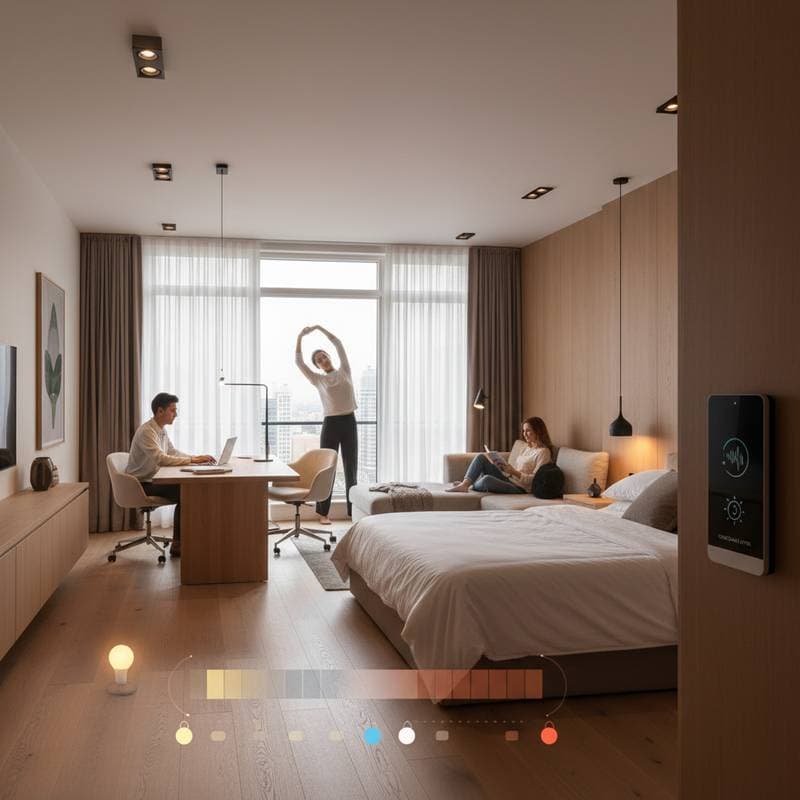
Picture awakening to a gentle golden illumination that softly permeates your bedroom, rather than a jarring alarm. As evening approaches, the light transitions to a soothing amber hue that encourages relaxation. This setup represents more than a high-end amenity; it embodies a residence attuned to your circadian rhythm, promoting sustained focus, vitality, and restorative sleep on a daily basis.
Numerous individuals endure unchanging artificial illumination throughout their routines. Such conditions often lead to exhaustion, disrupted rest, and a vague unease. The human body depends on daylight signals to manage hormones, vigilance, and emotional states. Disruptions in these light patterns cause the internal clock to falter. Circadian smart lighting addresses this by harmonizing indoor illumination with the biological cycles the body anticipates.
The Importance of Circadian Lighting
The circadian rhythm constitutes the body's inherent 24-hour cycle that dictates sleep, arousal, and vitality. Daylight naturally intensifies to cooler, brighter tones by midmorning before easing into warmer amber shades at dusk. Circadian smart lighting replicates this sequence within enclosed spaces. The focus extends beyond mere intensity to encompass color temperature and precise timing aligned with physiological needs.
Alignment between lighting and rhythm yields noticeable benefits, including heightened daytime concentration, diminished mid-afternoon lulls, and smoother nocturnal transitions to sleep. Individuals who adopt these systems frequently describe lessened ocular fatigue and elevated mood following the change to circadian-capable bulbs.
Mechanisms of Smart Lighting Synchronization
Circadian lighting employs adjustable white LEDs capable of altering color temperatures on demand. Morning exposure to vivid, cool tones prompts physiological awakening. Evening shifts to subdued, warm illumination stimulate melatonin release, facilitating superior rest.
These bulbs link to Wi-Fi networks or central hubs, relying on programmed timelines or environmental detectors for daily modifications. Certain configurations interface with fitness wearables or voice-activated devices, forming an integrated wellness network responsive to personal habits.
The following outlines steps to incorporate this technology into your living area.
1. Selecting Appropriate Smart Bulbs
Begin in primary areas such as the bedroom, workspace, or cooking zone. Prioritize options featuring adjustable white tones and programmable controls.
- Affordable option: Wyze Bulb Color (approximately $15 per unit). This model provides variable white and hue adjustments via mobile application scheduling.
- Intermediate choice: Philips Hue White Ambiance (about $30 per bulb). It incorporates a predefined circadian sequence and compatibility with Alexa, Google Home, and Apple HomeKit platforms.
- High-end selection: Nanoleaf Essentials A19 (roughly $40 per bulb). This variant enables location-based adaptive illumination that follows local sunrise and sunset schedules.
Practical advice: For existing Hue Bridge users or equivalent systems, compatible add-on bulbs ensure uniform color rendering across spaces.
2. Establishing Your Daily Lighting Cycle
Leverage the accompanying application to design a regimen echoing natural light variations. For instance, configure bulbs to deliver cool white at 5000K during mornings, then taper to 2700K as night falls. Applications from LIFX and Nanoleaf offer preset "circadian" or "day-to-dusk" functions to handle these shifts autonomously.
For those favoring hands-on oversight, implement three key phases daily: morning activation, midday alertness, and evening relaxation. Monitor personal responses and refine settings within the first week.
3. Linking with Complementary Smart Devices
To amplify wellness effects, pair lighting with additional intelligent appliances:
- Smart thermostats synchronize ambient temperature fluctuations with light alterations, cultivating holistic comfort.
- Voice assistants enable instant commands, like activating "evening mode" for dimming.
- Sleep monitoring tools initiate progressive brightening as lighter sleep phases occur.
Platforms such as Home Assistant or SmartThings facilitate fusion with occupancy detectors. Consequently, illumination adapts in real time upon room entry or exit.
4. Optimizing Placement and Multi-Layer Approaches
Optimal circadian effects arise from diverse light origins. Overhead installations supply broad coverage, supplemented by task-oriented desk lamps or cabinet-embedded strips using tunable elements.
Consider direct visual exposure, as light entering the eyes impacts melatonin regulation more profoundly than peripheral glow. In evenings, direct fixtures away from the gaze and emphasize diffused sources for comfort.
5. Cost and Setup Considerations
Initiate with a modest investment below $50, covering two bulbs and a foundational schedule. Comprehensive room-wide implementations range from $300 to $600, scaled to coverage extent.
Standard smart bulbs fit conventional sockets without electrical alterations. For upgrading embedded cans or installing strip lights, engage a qualified electrician to ensure compliance. Deactivate power sources prior to handling any connected elements.
Enhancing Outcomes with Expert Strategies
- Refrain from blending brands within a single area to prevent discrepancies in color temperatures at identical settings.
- Maintain updated firmware to optimize automation reliability and minimize connectivity issues.
- Shift workers should customize timelines to align with personal rest periods, prioritizing interval consistency over absolute hours.
- Pair with light-blocking drapes or adjustable blinds to shield against external interference with internal cues.
Embracing Seamless Daily Illumination
With automated adjustments in place, the system operates unobtrusively, which aligns with its purpose. Appropriate timing and tones bolster physiological functions subtly throughout routines. Adopters often experience invigorated mornings and expedited sleep onset within weeks.
Future expansions accommodate motion detectors or synchronized switches to evolve alongside habits. This scalability supports progressive enhancements without full overhauls.
Circadian smart lighting stands as an accessible pathway to wellness enhancement. It reconfigures living spaces to nurture innate patterns of activity, productivity, and recovery.