Integrating Digital Car Keys with Smart Locks
Smart homes advance past voice controls and mobile applications. Recent developments link daily devices in subtle, intuitive manners. A prominent advancement permits the digital key from your vehicle to unlock your front door, forming a cohesive ecosystem for your car and residence grounded in secure ultra-wideband technology.
Evolution of Digital Car Keys
Digital car keys originated as features for user convenience, permitting drivers to unlock and ignite vehicles through smartphones or smartwatches. These keys employ near-field communication, Bluetooth, or ultra-wideband signals to confirm proximity and user identity. With increasing adoption, vehicle manufacturers and technology firms recognize the potential to extend these keys beyond cars to serve as universal credentials for connected devices, such as residential smart locks.
Research indicates that numerous drivers currently utilize digital keys or show interest in adoption. The attractions include reduced physical keys, quicker entry, and improved security measures. Building on this base, the extension of digital identity to home access represents a natural progression.
Technology Enabling the Connection
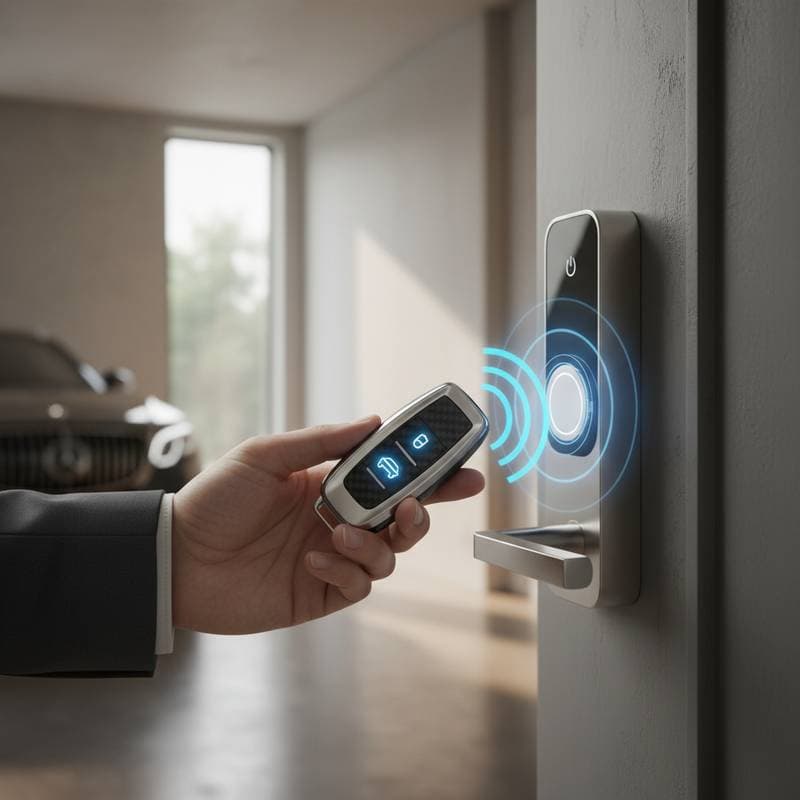
Ultra-wideband technology forms the foundation of this advancement, offering short-range wireless communication with precise location detection. Distinct from Bluetooth, which identifies only broad proximity, ultra-wideband determines exact device positions relative to locks or sensors. Consequently, a smart lock detects the vehicle's digital key precisely at the entrance, distinguishing it from distant or misplaced locations.
Manufacturers explore pairings of these systems through announced collaborations between automakers and smart lock providers, establishing shared access protocols. Upon parking the vehicle and approaching the residence, the digital key that verified vehicle access triggers the front door unlock automatically. This process involves instantaneous encrypted data exchanges, rendering the interaction seamless.
Benefits for Daily Routines
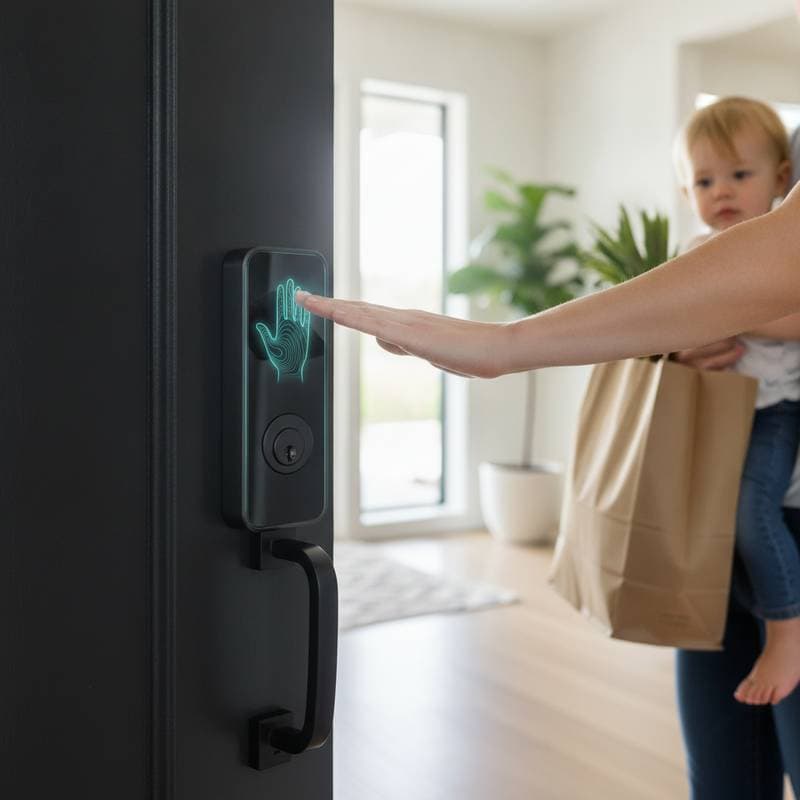
Such integration transforms everyday convenience. Consider returning home carrying groceries: the vehicle identifies the digital key, deactivates, and upon nearing the door, the residence unlocks without additional actions. Users avoid retrieving phones or keychains, as the system verifies authorization independently.
Security improves significantly as well. Ultra-wideband resists relay attacks, where intruders simulate key proximity. With accuracy to centimeters, the lock confirms physical presence at the door prior to access, surpassing traditional wireless methods that rely solely on signal detection.
Current Implementations and Demonstrations
Apple, Samsung, and various automakers advance digital key systems supporting ultra-wideband and secure vehicle-to-device interactions. Smart lock producers incorporate these frameworks, allowing the car's digital key to function as home entry credentials. Hyundai and BMW showcase this capability within interconnected environments.
Smart home specialists develop compatibility protocols to associate vehicle profiles with residential locks. As the vehicle enters the driveway, the garage activates, exterior lights illuminate, and the front door readies for unlock, all initiated by one digital key transmission.
Advancing Unified Smart Environments
This pattern aligns with the expansion of integrated smart systems. Users prefer unified interfaces over fragmented applications for devices like vehicles, cameras, and climate controls. Digital key connections fulfill this demand by streamlining access across mobility and home functions.
Linking transportation with residential entry dissolves boundaries between travel and domestic spaces. The vehicle extends the smart home network, while the residence functions as an adaptive assistant. This setup opens possibilities for managed sharing, where family members gain provisional digital keys valid for both vehicle and home, featuring adjustable permissions and durations.
Challenges in Adoption and Solutions
Implementation hinges on compatibility and user confidence. Vehicles and residences do not yet uniformly support identical standards. Some individuals prefer physical alternatives for security, wary of fully digital reliance. Data privacy concerns arise, requiring robust encryption and consent-based sharing in location systems.
Industry alliances develop universal standards for key exchanges. Automakers, mobile device makers, and home technology firms establish cross-platform authentication protocols. As these evolve, the functionality grows uniform and dependable.
Embracing Integrated Access Solutions
The appeal lies in alignment with routine habits, demanding no new learning or management. Systems identify and accommodate users naturally. Families benefit from simplified coordination, eliminated lost keys, and heightened assurance. Technology advocates view this as progress toward interconnected living where devices interact fluidly.
Anticipating Widespread Connected Access
Ongoing partnerships between vehicle and home brands position this integration as commonplace in future systems. It reshapes secure entry concepts, intuitively combining travel and home life. These developments craft responsive surroundings that align with individual patterns, prioritizing recognition and adaptation.