Envision Effortless Floor Maintenance
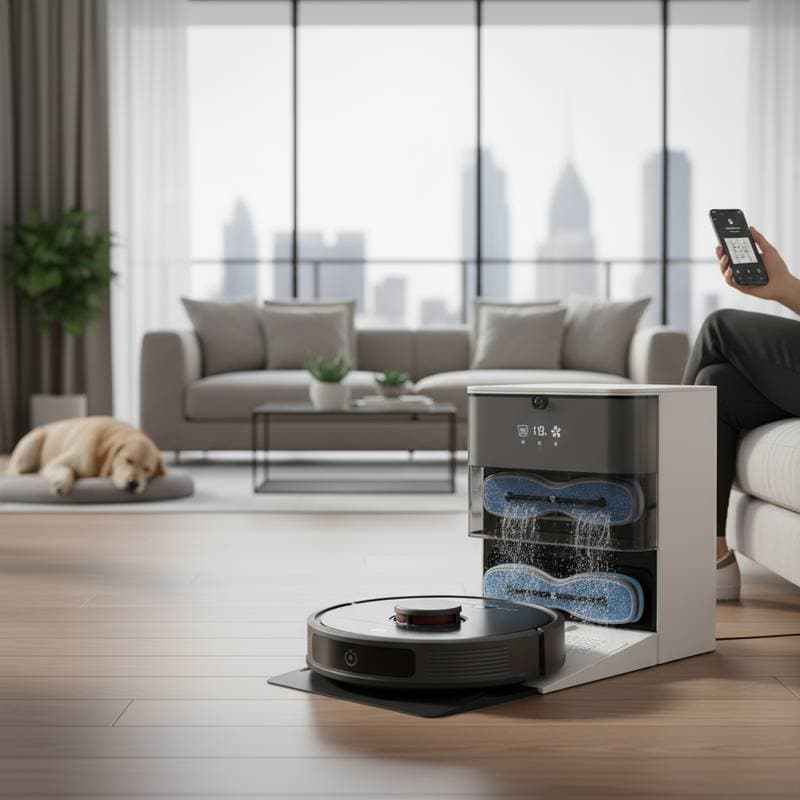
Return home after a demanding day to discover floors that shine without visible effort. No lingering dirt, no scattered debris, and no soiled cleaning tools demand attention. The solution operates discreetly from its charging station: a self-cleaning robot vacuum that performs both vacuuming and mopping while managing its own pad hygiene.
Homeowners often view floor care as an ongoing burden. Although robot vacuums have gained popularity, many require manual intervention for pad rinsing, tank refilling, or waste disposal. The newest self-cleaning robot vacuums eliminate these tasks. Initiate the process, and the device manages vacuuming, mopping, rinsing, drying, and recharging autonomously.
Addressing Common Cleaning Obstacles
Earlier robot vacuums introduced automation, yet limitations persisted. Streaks might appear on tiles, pads could remain damp, or unpleasant smells develop from prolonged moisture in the dock. The full cleaning process lacked complete independence. In homes with pets, challenges intensify as hair clogs brushes and fresh tracks from paws undo progress.
Self-washing models resolve these primary concerns of upkeep and sanitation. Current innovations rinse pads with clean water, scrub them via internal mechanisms, and apply heated air for drying to inhibit mold growth. Owners invest less time while achieving superior cleanliness.
Core Components of the System
A self-cleaning robot vacuum with automated mop care integrates three essential functions:
- Vacuuming and debris collection to capture dust and particles.
- Dynamic mopping through rotating or oscillating pads for thorough surface treatment.
- Automated upkeep in the dock, which cleans, dries, and replenishes the mop assembly.
These units excel in environments with diverse surfaces, including hardwood, tile, and low-profile carpets. Unlike predecessors that necessitated manual adjustments, modern versions detect floor types and adjust mop height or engagement accordingly.
Technical Mechanisms Explained
The docking station features separate reservoirs: one for fresh water to cleanse pads and another to capture wastewater post-cycle. Upon return, the robot aligns pads with rotating brushes that agitate and flush them. Select systems employ warm airflow to evaporate moisture, minimizing bacterial proliferation and scents.
Navigation relies on LiDAR scanning paired with 3D obstacle sensing. The device generates a digital layout of the residence, designating restricted areas such as carpets or pet feeding zones. The associated mobile application enables scheduling, water level adjustments, and real-time monitoring of the cleaning path.
Consider this expert recommendation: select units supporting dual-pass mopping, where the robot traverses areas twice with renewed water. This method yields superior outcomes on adhesive residues in kitchens over single traversal approaches.
Selecting the Ideal Self-Cleaning Robot Vacuum
Identify Specific Requirements
Determine primary challenges in your routine. For pet owners, seek high-powered suction and anti-tangle rollers. In areas with polished tile or protected hardwood, emphasize controllable water dispersion.
Assess Docking Station Functions
The base unit drives the automation. Basic models provide cold-water rinsing, whereas high-end variants incorporate heated drying and dust auto-evacuation. Opt for stations with integrated pad drying to minimize intervention.
Review Navigation Precision
Mapping technologies vary in accuracy. Prioritize LiDAR fused with optical sensors for evading items like cables, footwear, or animal droppings.
Verify Smart Home Integration
Contemporary units connect to platforms such as Alexa, Google Home, or Apple HomeKit. This compatibility supports voice activation and routine triggers tied to departure routines.
Account for Upkeep and Supplies
Advanced systems require periodic oversight. Replenish fresh water every few sessions and drain wastewater weekly based on frequency. Substitute pads and filters cost approximately twenty to forty dollars quarterly.
Recommendations Across Price Points
Entry-Level Pick: Eufy Clean X10 Pro Omni (Approximately $800)
The Eufy Clean X10 Pro Omni provides accessible self-cleaning capabilities. It delivers robust vacuuming, employs rotating mop pads, and performs post-run washing. The station manages dual tanks and elementary drying. Without dust auto-emptying, it suits compact spaces or single-story layouts effectively.
Balanced Option: Roborock Q Revo (Approximately $900)
Families appreciate the Roborock Q Revo for its 5,500 Pa suction and twin rotating mops that elevate over thresholds. The dock cleans and heats air-dries pads, countering humidity-related issues. The app facilitates targeted zones and timetables, with voice and multi-level support for expansive residences.
High-End Choice: Ecovacs Deebot X2 Omni (Approximately $1,400)
The Ecovacs Deebot X2 Omni exemplifies peak automation in a compact square form for edge access. Its station automates dust removal, water management, and pad drying. Ultrasonic detection identifies carpets promptly. AI-driven routing optimizes paths dynamically for efficiency.
Expert advice: Ecovacs devices receive firmware enhancements that refine navigation and avoidance, enhancing functionality over time.
Key Factors for Purchase Decisions
Financial and Recurring Expenses
Quality models range from $700 to $1,500. This investment supplants separate vacuuming and mopping tools, offsetting weekly manual efforts. Annual supplies for parts and solutions total fifty to one hundred dollars.
Placement and Spatial Needs
Position the dock on level ground near outlets, allowing side clearance. Proximity to plumbing simplifies refills. Utility spaces like laundry areas conceal it neatly.
Operational Safety and Care
Restrict tank additives to manufacturer solutions or mild cleaners to protect components. Update software via the app for optimal performance. On sensitive surfaces such as unfinished wood, trial low-moisture settings in isolated spots to prevent excess wetting.
Initial Configuration Timeline
Users typically complete unboxing and full mapping within sixty minutes. The device conducts an initial scan, followed by room designations and boundary settings. With filled tanks and power connection, complete cycles commence immediately.
Benefits of Comprehensive Automation
These appliances transform routines beyond mechanics, fostering a sense of liberation. Cleaning schedules fade, and post-meal tidying loses urgency as the device operates independently. Surfaces maintain steady hygiene rather than sporadic perfection.
Pet households benefit from uninterrupted fur and track management. Families with children value residue-free play areas free from microbial concerns. Energy use remains low, akin to a single bulb, while durable pads cut down on disposables.
Notable Enhancements to Consider
- Mop Elevation Sensors: Pads ascend upon carpet detection to avoid wetting.
- Heated Airflow Systems: Promote pad sanitation and longevity by eliminating dampness.
- Automated Debris Extraction: Docks transfer waste to bags lasting sixty days.
- Variable Hydration Levels: Tailor flow by area, light for delicate woods, intense for stones.
- Intelligent Avoidance: Cameras discern and navigate around common hazards.
Such capabilities reduce owner involvement, ensuring reliable outcomes.
Implementing Seamless Home Integration
Evaluate surfaces, configuration, and lifestyle to choose wisely. Compact dwellings favor the Eufy Clean X10 Pro Omni's simplicity. Pet-heavy, multi-story setups warrant the Ecovacs Deebot X2 Omni's sophistication.
Consult authenticated user feedback and warranty details prior to acquisition. Retailers may offer expert installation for docking, networking, and app setup. The enduring rewards include reclaimed hours and elevated living standards, with manual cleaning relics consigned to memory as automation prevails.
Frequently Asked Questions
How frequently must water tanks receive attention?
In typical use, refill clean water after two to three runs and empty wastewater concurrently for sanitation.
Do these units accommodate carpets?
Yes, sensors prompt mop lifting or area avoidance through programmed maps.
Are they suitable for hardwood?
They prove safe with minimal water settings on sealed surfaces; test inconspicuously first.
What is the noise level?
Operation ranges from 55 to 65 decibels, comparable to subdued speech; docking phases briefly elevate sound.
Require proprietary cleaners?
Adhere to brand formulas or water alone to safeguard mechanisms from residue or harm.
Duration of a standard cycle?
Expect one to two hours for comprehensive coverage, varying by area and intensity.
Remote scheduling possible?
Affirmative; apps permit control of timetables and sessions from any location.
Pad replacement process?
Affordable substitutes endure months; procure easily through standard channels.
These systems unite exacting sanitation, astute guidance, and independent care to achieve genuine autonomy in domestic tech. They promise immaculate environments and liberated schedules with minimal oversight.