Imagine a Home That Handles Cleanup Without You
You return home after a demanding day, set down your belongings, and notice the pile of dishes in the sink alongside crumbs on the floors. You intend to address these tasks after dinner, yet exhaustion sets in before you begin. Consider a scenario where your home manages both responsibilities independently while you relax.
This vision approaches reality. The current generation of smart cleaning robots extends beyond basic vacuuming. These devices mop floors, empty their own waste bins, and coordinate with dishwashers to manage post-meal tasks. Although the notion of a robot unloading a dishwasher appears advanced, connected ecosystems, intelligent sensors, and automated sequences make it feasible.
The Evolution Toward Complete Cleaning Autonomy
Early robot vacuums functioned primarily as amusing devices that collided with obstacles. Those initial versions collected surface debris yet faltered in corners, with pet hair, and across intricate floor plans. Today, multifunctional cleaning robots map entire residences, distinguish object categories, and prioritize rooms requiring attention.
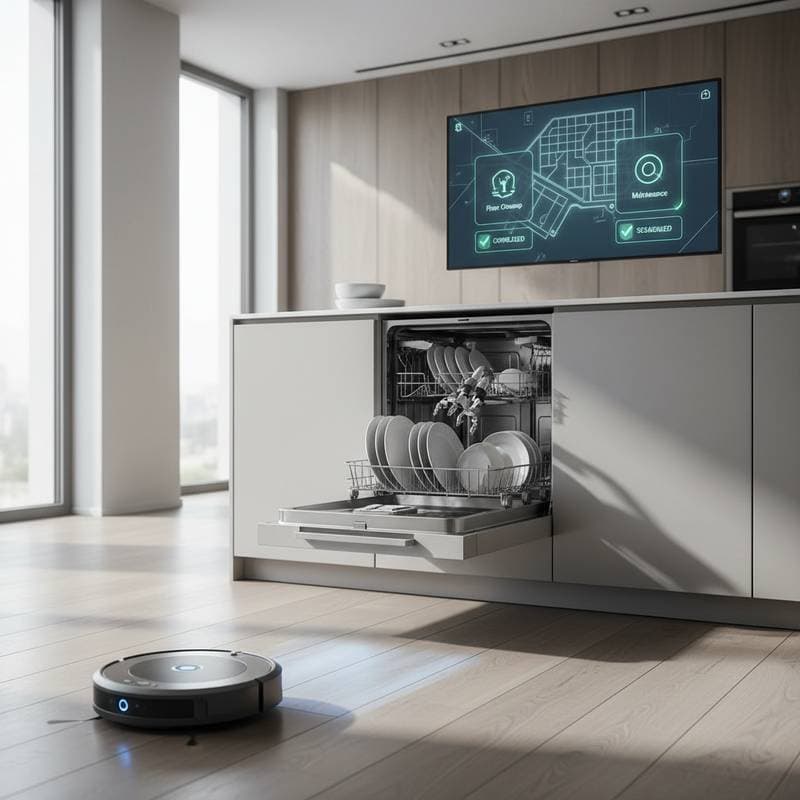
Contemporary smart cleaning robots integrate vacuuming, mopping, and waste management into a unified operation. Certain high-end models connect with dishwashers and kitchen appliances via central hubs, establishing coordinated cycles that address floors and dishes simultaneously.
The key advantage resides in genuine independence. Picture completing a meal, placing items in the dishwasher, and allowing the robot to tend to the floors as the dishwasher operates. Upon completion, the robot returns to its station, discharges its contents, and transmits instructions to the dishwasher for drying or cooling, preparing items for removal. Such integration represents practical innovation rather than distant fantasy.
Mechanisms for Managing Kitchen Tasks
Kitchens present challenging settings for automation due to spills, irregular surfaces, and confined spaces, requiring accuracy and flexibility. Advanced systems employ AI-driven mapping for environmental navigation and IoT protocols for device interplay.
In a standard configuration, the sequence unfolds as follows:
- Intelligent Mapping: The robot employs LiDAR or camera-based sensors to survey the kitchen, pinpointing the dishwasher location and frequent pathways.
- Schedule Establishment: Via a home automation application, define a post-meal routine that initiates both the dishwasher and cleaning robot.
- Device Interaction: Through platforms such as Amazon Alexa, Google Home, or Samsung SmartThings, the robot monitors dishwasher status and commences its operation once loading concludes and the area clears.
- Waste Disposal and Finishing: Following its task, the robot docks, ejects debris, and potentially activates the dishwasher's drying phase through predefined commands.
An often-overlooked capability involves sequential device operations. This functionality postpones floor cleaning until sensors verify the absence of residual heat or vapor from the dishwasher, avoiding moisture buildup on surfaces and maintaining hygiene and security.
Selecting an Appropriate Smart Cleaning Robot
Not all robot vacuums support advanced integration. Prioritize units with Wi-Fi access, compatibility with voice assistants, and routine-building features. The following options span budget levels.
Budget Selection: Eufy RoboVac X10 Pro ($499)
This unit delivers robust suction and essential navigation in a compact design. Integration with Alexa or Google Home enables timing alignment with dishwasher cycles. Although lacking self-emptying, it operates quietly and reliably in modest areas.
Mid-Range Selection: Roborock Q Revo ($899)
Equipped for vacuuming and mopping, this model includes a self-emptying base and accommodates various floor layouts. The accompanying application facilitates routine programming, such as initiating cleaning post-dishwasher completion. The base cleans and dries mop attachments, minimizing upkeep.
Premium Selection: iRobot Roomba Combo j9+ ($1,399)
Engineered for comprehensive automation, the j9+ vacuums, mops, and self-empties while leveraging iRobot OS for inter-device signaling. Paired with a suitable dishwasher via Alexa or SmartThings, it activates unified cleaning protocols. This suits expansive residences or open kitchens.
Expert Recommendation: iRobot OS analyzes usage patterns to propose optimizations. If patterns indicate frequent dishwasher activation after meals, it recommends aligning vacuum runs accordingly, fostering effortless automation.
Establishing an Integrated Cleaning Protocol
View your residence as an interconnected network where appliances contribute to daily efficiency. To maximize a vacuum-dishwasher pairing, follow this setup guide:
- Conduct Initial Mapping: Utilize the robot's software to chart the full layout, designating areas like the kitchen and dining space.
- Designate Restricted Areas: Configure barriers around the dishwasher to avoid disruptions during access.
- Develop an Automated Sequence: Within the smart home interface, associate the vacuum's schedule with the dishwasher's operation, such as commencing vacuuming 45 minutes after dishwasher start.
- Incorporate Monitoring Devices: Install humidity or temperature detectors to signal cycle completion, ensuring safe cleaning commencement.
- Evaluate and Adjust: Execute trials to optimize intervals; contemporary platforms simplify modifications.
Initial configuration requires approximately one hour yet yields substantial weekly time savings.
Key Factors in Automation Implementation
Prior to acquiring advanced equipment, evaluate these aspects.
Financial and Initial Investment
Prices for smart cleaning robots vary from below $300 to exceeding $1,500. High-end variants consolidate functions and endure longer, offsetting costs through reduced manual labor. Features like self-maintenance docks enhance usability at an added expense.
Upkeep and Supplies
Automated devices demand periodic care, including sensor cleaning, filter replacement, and solution replenishment. Select models with automated refill mechanisms to lessen intervention.
Surface Compatibility and Design
Optimal performance occurs on firm floors such as tile or wood. For mixed environments, opt for adaptive detection. Application-based virtual limits confine operations as needed.
Security and Standards
Verify UL certification and electrical compatibility for all components. Avoid overloading circuits with multiple units. Engage a qualified electrician for any custom installations.
Installation Duration
Systems typically require simple Wi-Fi pairing and hub linkage. Complete automation setup spans a few hours.
The Significance of Coordinated Home Systems
Appliance synchronization extends beyond convenience, signaling a transformation in residential technology. Cleaning automation prioritizes time recovery and cognitive relief over total replacement of human involvement.
Residences evolve into responsive environments where devices adapt to routines, illumination, and activities. Vacuums respond to meal times; dishwashers prepare subsequent phases.
Developers explore prototypes with mechanical arms for direct dish handling, though consumer versions remain forthcoming. These advancements indicate automation's trajectory.
Integrating Automation into Daily Life
Begin modestly by linking existing devices through a hub. Tailor sequences to habits, including:
- Floor maintenance following meals
- Operations during low-energy periods
- Vacuum activation post-departure for the day
For assistance, consult certified installers via local services. Many provide complimentary assessments.
Implementation yields prompt benefits: subdued device operations underscore a self-sustaining environment. Evenings gain ease, mornings commence orderly, and chores cease to dominate schedules.
Sustaining an Automated Cleaning Environment
Within weeks, reliance on these systems solidifies into routine. Devices preempt disarray, allowing focus elsewhere. Kitchen arrangements may evolve to complement automation.
Expansion options include intelligent waste containers, surface monitors, or supplementary units for counters. These enhancements amplify the core framework, rendering the kitchen largely self-managing.
Frequently Asked Questions
Do all robot vacuums integrate with dishwashers? No, only models with IoT compatibility and smart hub support enable coordination. Verify specifications before purchase.
How much time does setup require? Basic connections take minutes; full routines may need an hour or two for testing.
Are these systems safe for homes with pets or children? Yes, with proper zone settings and obstacle avoidance, though supervision during initial runs is advisable.
What if my dishwasher lacks smart features? Basic models can connect via smart plugs for timed activation, bridging compatibility gaps.