Holographic Displays Set to Replace Smart TVs by 2026
Smart homes continue to reshape daily life, yet the forthcoming advancement in immersive entertainment renders traditional flat screens obsolete. Holographic displays emerge as the pinnacle of visual innovation, delivering free-floating 3D imagery that captivates viewers. This evolution extends beyond enhanced clarity to introduce novel methods of engagement, observation, and connectivity. As living rooms transform into dynamic hubs, holographic systems promise to redefine the essence of television viewing.
From Flat Screens to Floating Worlds
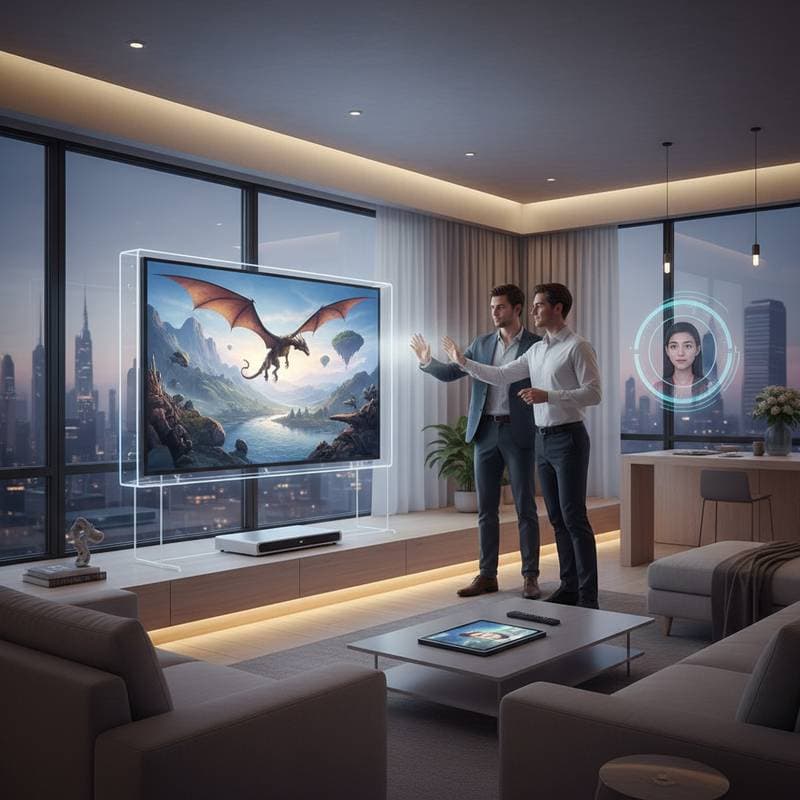
Smart televisions have long served as the focal point of integrated residences, facilitating streaming services, voice-activated controls, and synchronization with ambient lighting or audio setups. However, even the most sophisticated models remain confined to two-dimensional panels. Holographic displays revolutionize this paradigm by generating three-dimensional projections that require neither eyewear nor specialized headgear, yielding visuals that convey lifelike depth and tangibility.
This progression aligns with escalating demands for participatory media consumption. Research indicates a surge in preference for interactive and authentic content among audiences, which holographic technology fulfills precisely. Envision a live concert materializing within your space or a culinary demonstration featuring a full-scale instructor adjacent to your workspace. Such scenarios, once relegated to speculative fiction, now approach practical realization.
1. True 3D Visualization
Holographic displays achieve profound depth and immediacy through precise light field modulation, producing authentic three-dimensional renderings. In contrast to standard screens that depend on planar pixels, these systems emit light patterns that the human eye perceives as volumetric structures. This method attains a degree of verisimilitude unattainable by existing television formats.
The inherent viewing ease stands out as a key advantage, permitting unrestricted movement while maintaining accurate spatial perception, free from accessories. Enterprises such as Looking Glass Factory and Leia Inc. have unveiled prototypes that render intricate holograms observable from diverse perspectives. With declining costs, domestic entertainment evolves from passive observation to active immersion.
2. Interactive Viewing Experiences
Beyond visual enhancement, holographic technology facilitates direct user involvement. Advanced models incorporate gesture recognition, eye-tracking, and vocal directives, enabling seamless content manipulation. Users might swivel a featured item in an advertisement or magnify elements within a digital gallery exhibit through simple hand motions.
Such interactivity reshapes commonplace activities. Households could convene around a holographic athletic highlight, examining maneuvers from varied viewpoints. Children might explore scientific principles via manipulable 3D simulations. For marketers and content producers, this opens avenues for narrative forms that emphasize audience agency over mere spectatorship.
3. Seamless Smart Home Integration
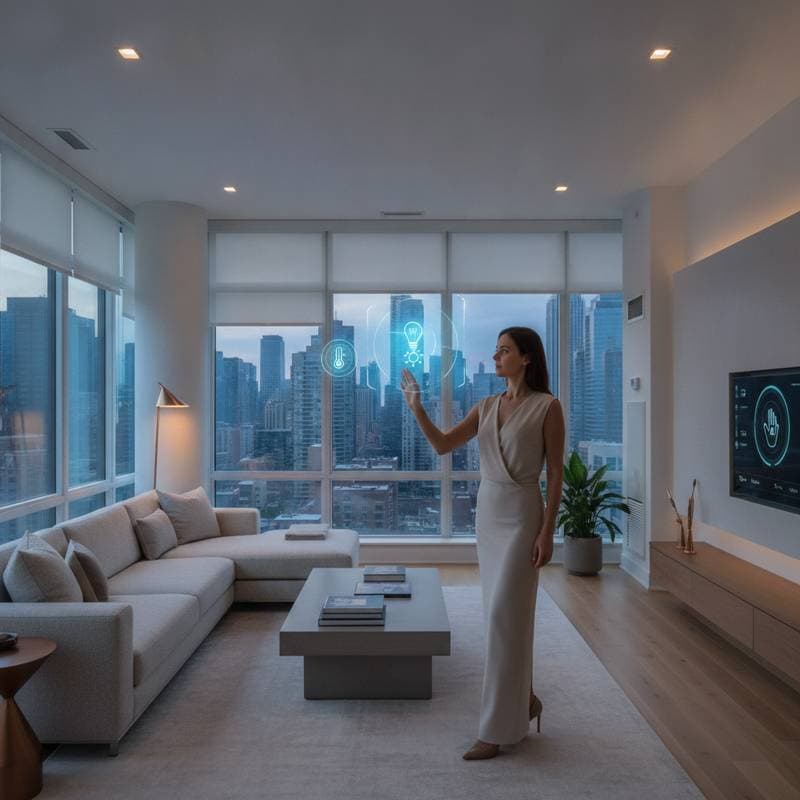
Contemporary smart televisions link with peripherals like illumination and acoustics, yet holographic platforms elevate this connectivity. They interface with digital assistants, environmental sensors, and automation cores to foster adaptive surroundings. Upon occupying a seat, the system might calibrate illumination and audio levels according to occupant positioning. In virtual conversations, participants manifest as full-bodied holograms positioned naturally within the space.
Experts anticipate broader adoption of protocols like Matter, ensuring holographic devices harmonize within expansive smart ecosystems. Consequently, residences gain heightened responsiveness and customization tailored to individual preferences.
4. Compact and Minimalist Design
Conventional displays often encroach upon available area, whereas holographic units prioritize unobtrusive aesthetics. Prototypes frequently employ translucent surfaces or discreet emitters that retract when idle, aligning with contemporary preferences for streamlined and adaptable interiors.
A single holographic device could supplant televisions, computer monitors, interactive assistants, and digital displays alike, serving as a versatile hub. It adjusts dynamically to tasks, from cinematic viewing and informational queries to facilitating remote social engagements.
5. Social and Shared Experiences
While streaming services have individualized leisure pursuits, holographic displays revive communal dynamics. Picture a performance event projected into your environment or a familial assembly augmented by life-sized remote projections. This capability nurtures authentic relational bonds, rendering online exchanges more intimate.
Emerging ventures develop real-time volumetric communication tools, allowing participants to embody spatial forms. Applications extend to professional collaboration and pedagogical settings, where educators materialize in learners' areas for conceptual clarification or teams deliberate over shared three-dimensional prototypes in virtual proximity.
6. Energy Efficiency and Sustainability
Large flat-panel screens demand substantial electricity, but holographic projectors leverage light field and laser mechanisms for optimized performance. These designs direct illumination selectively, minimizing excess energy and thermal output compared to full-panel backlighting.
Producers investigate eco-friendly substances and interchangeable parts to simplify maintenance and material recovery. Environmentally conscious consumers thus encounter an option that balances superior functionality with reduced ecological footprint.
7. Gaming and Immersive Media
Video games frequently pioneer visual breakthroughs, and holographic displays prove transformative in this domain. By constructing characters, settings, and dynamics in full dimensionality, they instill unparalleled authenticity. Participants navigate scenes physically, shifting perspectives as though embedded within the narrative.
Software developers craft rendering frameworks compatible with holography, while studios innovate plot structures exploiting spatial elements. This convergence dissolves boundaries among gaming, cinema, and theatrical arts, converting domestic spaces into versatile interactive arenas.
8. Barriers and Breakthroughs Ahead
Emergent technologies invariably encounter obstacles, including elevated production expenses, scarce compatible media, and requirements for robust computational resources. Producers of content must acquire specialized authoring suites for efficient holographic output. These issues parallel the initial impediments to smart television proliferation, which dissipated with cost reductions and content proliferation.
Industry projections suggest that scaled manufacturing and rising demand will accelerate holographic integration, mirroring past trends. Major streaming providers test three-dimensional formats, preparing infrastructure for novel presentation modes. Widespread content availability will expedite the migration from planar to projective displays.
9. The Consumer Advantage
For typical households, holographic benefits transcend gimmickry to deliver practicality, ergonomics, and ingenuity. These systems consolidate multiple interfaces, accommodate inclusive viewing geometries, and conform to personal rhythms. They integrate fluidly with expanding smart apparatuses, including vocal controls and networked fixtures.
Consider initiating the day with a suspended meteorological update over your morning routine or convening in sessions where peers project at natural scale. Prototypical implementations already validate these utilities, positioning holography as an accessible enhancement.
Embracing Holographic Integration in Daily Life
Holographic displays mark not merely an incremental improvement but a profound reconfiguration of digital interaction. Residences gain interactivity, media acquires vitality, and leisure merges indistinguishably with routine functions.
As refinement progresses, distinctions between tangible and virtual realms diminish further. Living areas transcend fixed displays to embody fluid visual environments responsive to sentiments, pursuits, and engagements alike.