The Future of Smart Cleaning: Beyond Vacuuming and Mopping
Picture returning home after a demanding day to find spotless floors and neatly folded laundry, all without personal effort. This scenario moves from imagination to reality as smart cleaning technology advances rapidly. Current developments in robot vacuums that integrate mopping and laundry folding signal a transformative era in home automation.
Homeowners increasingly seek devices that reclaim valuable time while ensuring a tidy living space. Traditional options limit users to separate tools for vacuuming or mopping, but emerging multifunctional units address this gap. Robotics firms now develop systems that perform multiple tasks seamlessly, accelerating the shift toward comprehensive home assistance.
Advancements in Hybrid Cleaning Systems
Smart cleaning technology has evolved significantly from basic robotic vacuums that struggled with navigation. Modern models create detailed floor maps, evade obstacles like cords, and manage self-emptying dustbins. The integration of mopping capabilities marks a key progression, with laundry handling poised as the subsequent innovation.
These developments align with broader trends in connected home ecosystems under the smart cleaning umbrella. Systems employ advanced sensors, adaptive navigation, and machine learning to execute various cleaning functions with little user oversight. The emphasis rests on delivering reliable results, from pristine surfaces to organized apparel, without ongoing monitoring.
Core Mechanisms Behind the Technology
Hybrid robots typically incorporate interchangeable modules for versatile operation. A vacuum attachment captures dry particles, while a reservoir and cloth pad manage liquid-based cleaning. Advanced prototypes feature bases that automatically clean and replenish the mopping elements, reducing maintenance needs.
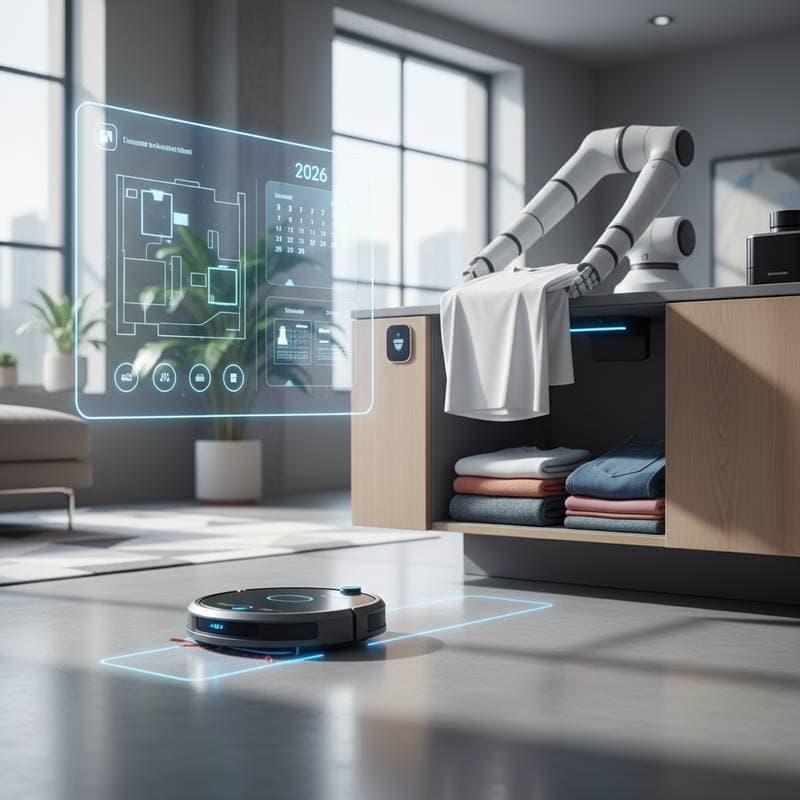
Laundry processing extends this modular approach. Equipped with visual recognition tools, robotic manipulators identify material compositions, outline edges, and arrange items into precise folds. Select firms experiment with standalone folding units that link wirelessly to laundry appliances, enabling coordinated workflows.
Key insight: Progress hinges on refined artificial intelligence for item differentiation, such as distinguishing between socks, linens, and blouses. Reliable implementation of this software will enable robots to outperform manual efforts in efficiency, transforming household routines.
Current Devices to Consider for Future-Proofing
To prepare for upcoming multifunctional capabilities, evaluate hybrid vacuum-mop systems available today. These models establish compatibility with expanded features, including eventual laundry integration through firmware updates or attachments.
1. Entry-Level Selection: Eufy X10 Pro Omni (Approximately $700)
This unit performs vacuuming and mopping in tandem, leveraging artificial intelligence to bypass rugs during wet cycles. It delivers strong aspiration, automated pad maintenance, and reservoir replenishment. Ideal for compact residences, it introduces essential automation principles.
2. Intermediate Option: Roborock S8 Pro Ultra (Approximately $1,600)
Featuring paired rubber rollers, vibrational mopping, and a station that launders and dehydrates pads, this device minimizes intervention. It supports dustbin evacuation and fluid management, with application controls for level-specific mapping, timetables, and voice assistant compatibility via Alexa or Google Home.
3. High-End Choice: Dreame X30 Ultra (Approximately $1,800)
Among the forefront hybrids, it incorporates perceptive barrier avoidance, heated water pad cleansing, and odor-preventing ventilation. The self-sufficient base operates with scant oversight, positioning it as a benchmark for evolving smart cleaning standards.
These selections provide scalable entry points. As laundry functions emerge, existing platforms will adapt, ensuring longevity in investments.
Design and Functionality of Laundry-Capable Robots
Anticipate compact configurations resembling modest furniture pieces, complete with a planar workspace, articulated limbs, and integrated imaging. The device retrieves articles from hampers, flattens wrinkles, and categorizes folds by textile properties. Prototypes demonstrate proficiency in dimension-based sorting and drawer organization.
For users with intelligent laundry equipment, synchronization proves straightforward. Upon cycle completion signals from dryers, the robot retrieves, processes, and alerts via mobile notifications. Initial iterations may require human aid for intricate or irregular items, yet automation of staples like tops, cloths, and trousers offers substantial relief.
Key Factors for Implementation
Initial multifunctional models will carry premium pricing, ranging from $2,000 to $3,000. Economies of scale will gradually align costs with high-end vacuums. Time savings from delegated tasks justify the outlay, freeing hours for preferred activities.
Setup demands minimal complexity, relying on proximity to electrical sources, wireless connectivity, and routine synchronization. Occasional water additions support mopping, far less burdensome than conventional methods. Prioritize certified products adhering to safety protocols, particularly for combined water and power elements. Secure networks and prompt updates safeguard integrated setups.
Insights for Pioneering Users
Leading innovations stem from alliances between specialized robotics ventures and major appliance producers, merging hardware prowess with digital analytics. Such partnerships expedite timelines, surpassing isolated efforts.
A noteworthy aspect involves aggregated mapping intelligence. Devices contribute anonymized spatial data to refine brand-wide algorithms, enhancing collective accuracy and adaptability over time.
Integrating Smart Cleaning into Daily Life
Adopting hybrid systems that evolve toward laundry automation fosters a seamless, interconnected household. Repetitive duties recede into automated processes, elevating overall quality of life. Begin by acquainting with current hybrids to master navigation essentials. Laundry-enabled variants will integrate effortlessly thereafter. For guidance, explore vetted specialists via xavagetech.com Marketplace to optimize your setup.
Frequently Asked Questions
When will laundry-folding robots become widely available? Projections indicate market entry by 2026, starting with premium models.
Do these devices require professional installation? No, they connect via standard outlets and Wi-Fi, though app configuration may benefit from initial support.
How do they ensure safety around pets or children? Built-in sensors detect and avoid living beings, with pause functions for unexpected interactions.
Can they handle all types of clothing? Early versions excel with everyday items but may need assistance for delicates or accessories.
What maintenance is involved? Periodic emptying of waste compartments and water checks suffice, with self-cleaning features handling most upkeep.