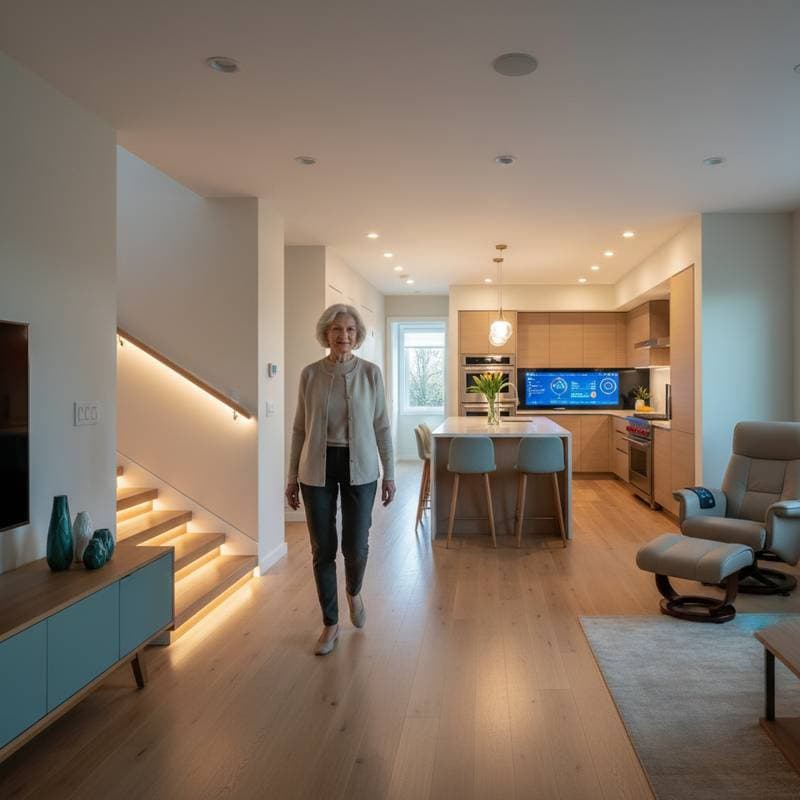
When Smart Home Technology Serves as a Safety Net
Picture an elderly parent rising at night for a glass of water. The hallway lies in darkness, the floor feels cold, and a single misstep might result in a serious fall. This scenario troubles many families. Falls rank among the leading causes of hospitalization for older adults, with recovery periods that often extend for months. Fortunately, smart home technology now prevents approximately 80 percent of such incidents by converting everyday spaces into intelligent, responsive environments.
The Challenges Families Encounter
Caring for aging parents or relatives involves a blend of affection and concern. Families desire independence for their loved ones yet seek reassurance. Conventional safety aids, such as grab bars or non-slip mats, provide limited protection. Risks frequently arise from inadequate lighting, forgotten medications, or undetected health shifts. Smart home systems address these issues by discreetly observing daily patterns and identifying problems before they escalate.
How Smart Home Technology Reduces Fall Risks
Smart home safety solutions for seniors align with the category of Smart Health and Wellness. These integrate sensors, lighting, and monitoring devices to safeguard older adults without transforming homes into clinical settings. The systems extend beyond emergency responses; they foresee potential dangers.
Motion sensors that identify nighttime activity can activate gentle illumination to light the path. If an individual lingers unusually in one area, the system notifies a caregiver. Smart thermostats contribute by maintaining comfortable temperatures in hallways, which helps prevent stiffness that impairs balance.
Professional insight reveals that certain advanced platforms employ behavioral pattern learning. These adapt to an individual's typical routines. Gradually, the system distinguishes between standard evening activities and irregular behaviors that indicate a heightened fall risk.
Key Smart Devices for Enhanced Safety
1. Smart Lighting to Support Safe Movement
Lighting represents a straightforward enhancement that yields substantial safety benefits. Motion-activated lights installed in hallways, bathrooms, and bedrooms help avert disorientation during nighttime hours.
- Affordable choice: The Wyze Bulb Color, priced at about $15 per unit, enables motion-triggered automation via the Wyze app and compatibility with Google Home.
- Moderate investment: The Philips Hue Motion Sensor Starter Kit, at roughly $120, includes adjustable brightness and scheduling options to ensure lights remain subdued and avoid full awakenings.
- High-end option: The Lutron Caséta Smart Lighting System, starting at around $200 for a basic kit, integrates with Apple HomeKit, Alexa, and Google Assistant for control through voice commands or apps.
Such setups activate upon detecting foot contact with the floor, illuminating pathways to minimize tripping while avoiding intense light.
2. Sensors for Fall Detection and Monitoring
Motion and presence sensors have advanced considerably past simple tracking. Contemporary versions utilize radar or infrared technology to identify falls without requiring wearable devices.
- Affordable choice: The Amazon Echo Show 8 paired with Alexa Together, at about $130, provides video monitoring with drop-in access and voice notifications for caregivers.
- Moderate investment: The Google Nest Hub Max, priced at approximately $230, facilitates remote check-ins and connects to fall detection via third-party integrations.
- High-end option: The Vayyar Care Home Monitoring System, costing around $250 per room, employs radio wave imaging to sense falls in areas like bathrooms where cameras prove unsuitable.
Installers recommend pairing radar sensors with conventional motion detectors. Radar handles privacy-focused zones, whereas motion sensors manage broader areas. This combination diminishes false alarms and boosts dependability.
3. Smart Flooring and Voice Assistance
Certain sophisticated installations incorporate pressure-sensitive flooring that registers falls or prolonged immobility. Though these remain costly, they emerge in luxury assisted living facilities and adapt to private residences.
Pair these with voice-activated assistants such as Alexa or Google Assistant. A straightforward command like "Help me" initiates a call or alert to family members. When linked to fall sensors, this forms a comprehensive protective layer.
4. Tracking Health and Activity Levels
Devices like the Apple Watch SE, at about $250, and the Fitbit Sense 2, around $300, sense abrupt motion changes and promptly contact emergency services. Home platforms can synchronize these signals to activate lights, disengage door locks for responders, or dispatch alerts to caregivers.
Integration stands as the core strength of smart home technology. It extends past mere convenience to establish a unified safety network.
Essential Factors for Implementation
Fall prevention through smart homes begins modestly. Initial costs range from $100 for basic motion lights to over $1,000 for comprehensive monitoring. Focus on high-traffic zones first. Bedrooms, hallways, and bathrooms yield the most immediate safety improvements.
- Costs: Smart bulbs cost $15 to $50, monitoring hubs $100 to $300, and radar sensors up to $250 per room.
- Setup: Lighting kits suit do-it-yourself efforts. For wired or ceiling-mounted sensors, engage a licensed electrician to comply with building codes and secure stable power.
- Privacy: Select systems with local data storage or encrypted cloud options. Examine privacy configurations on voice assistants.
- Duration: Simple installations finish in an afternoon; full-home systems require several days.
For complete services, consult certified installers via online platforms. Submit project details at no charge, obtain bids, and select experts familiar with accessibility features.
Building a Secure and Intelligent Living Space
These safety elements integrate effortlessly into routines. A dimly lit hallway, a subtle prompt from a voice assistant, or an unobtrusive sensor during a serene morning collectively foster tranquility. Technology supplements, rather than supplants, personal attention. It promotes autonomy and respect.
Evidence that such measures cut fall risks by up to 80 percent reshapes perspectives on aging at home. Residences evolve from mere dwellings into collaborative safeguards.
Steps to Get Started
Assess vulnerable home areas first. Install motion lighting as the initial measure, followed by sensors and communication devices. Gradually incorporate health monitors and climate controls.
During renovations, prepare for smart expansions. Request contractors to add neutral wiring in switch boxes and robust Wi-Fi throughout. These preparations simplify and economize future additions.