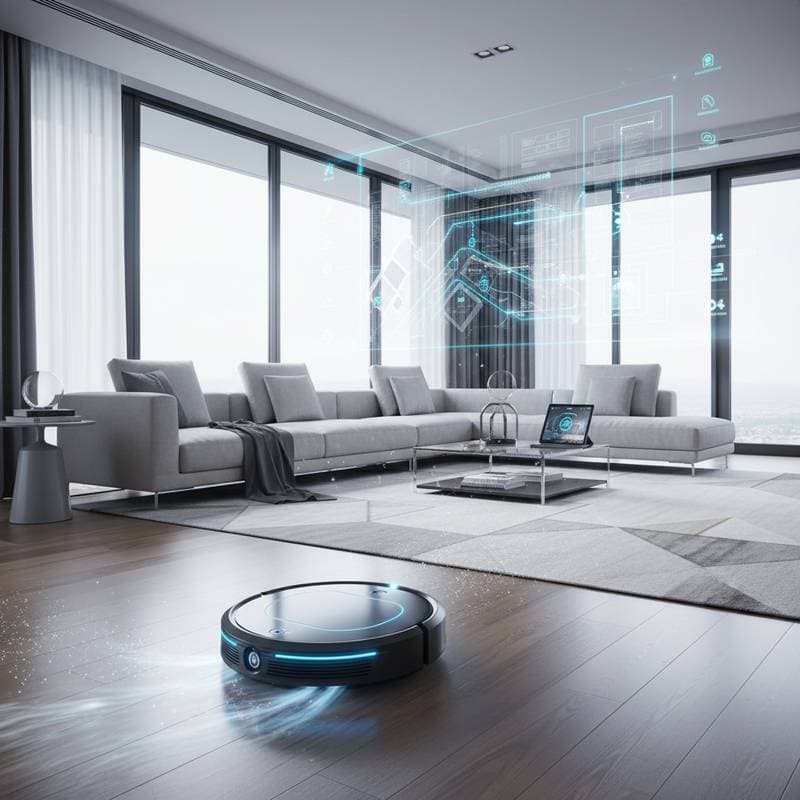
Persistent Floor Dirt Challenges Daily Life
Individuals often settle down with a cup of coffee, anticipating relaxation, only to spot crumbs under the kitchen light. Despite vacuuming the previous day, dust and pet hair reappear swiftly. Such recurring dirt chases frustrate many, particularly when schedules demand constant attention. Envision a cleaning process that operates independently, allowing focus on preferred activities.
The latest smart cleaning robots deliver precisely that capability. Technology in smart vacuums has progressed rapidly, astonishing industry observers. The forthcoming advancement represents a significant evolution. Developers are creating AI-powered robot vacuums capable of cleaning three times faster than existing models, while preserving thoroughness. This development extends beyond mere ease; it redefines perspectives on household upkeep and automation.
Importance of Enhanced Speed in Automated Cleaning
Initial robot vacuums managed basic debris yet demanded extended operation times. They frequently navigated randomly, overlooking floor sections. Despite enhancements in mapping and suction, numerous models require over an hour for a standard living space. Such durations restrict usage frequency, especially in homes with children or pets.
Accelerated cleaning yields brief cycles, reduced noise, and increased maintenance opportunities. Consequently, homes maintain cleanliness continuously, rather than solely post-schedule. With threefold speed, users can initiate a cleaning session after breakfast and another before visitors arrive, eliminating prolonged waits.
Innovations Powering Accelerated Performance
Upcoming AI robot vacuums integrate multiple technologies to elevate both velocity and precision:
- Adaptive Path Planning: Rather than adhering to predetermined paths, these devices evaluate floor layouts in real time. Equipped with onboard cameras and LiDAR sensors, they determine optimal cleaning orders and adapt immediately to alterations, such as relocated chairs or scattered toys.
- Dual Brush and Variable Suction Systems: Coordinating several brush mechanisms with adjustable suction enables broader coverage per pass. The system intensifies effort in targeted areas, like carpet borders or pet-frequented zones, while optimizing energy in others.
- Edge-Aware Mapping: Advanced AI interprets wall outlines and furniture edges with precision. This functionality permits effective corner cleaning without repeated collisions.
- On-Device Processing: Future models execute AI computations locally, minimizing dependence on cloud services. This approach diminishes delays, accelerates responses, and bolsters data privacy.
Industry experts highlight an emerging feature: multi-floor memory mapping surpasses basic level detection. Devices will recall rug positions beneath furniture, modulate suction for varying carpet depths, and anticipate dirt-prone zones prior to accumulation.
Selecting an Optimal Robot Vacuum
Upgrading requires discernment to distinguish superior options. The market offers variety, yet certain models excel in intelligence, performance, and affordability.
- Budget Selection: Eufy RoboVac G30 Verge (approximately $250): This entry-level unit provides reliable navigation and subdued operation. Although it omits sophisticated AI, it performs admirably in compact spaces or on low-pile carpets.
- Mid-Range Choice: Roborock Q Revo (approximately $900): A vacuum-mop hybrid with self-emptying, it employs LiDAR for mapping and completes full floors in less than an hour with steady suction. Compatibility extends to leading smart home platforms.
- Premium Option: iRobot Roomba Combo j9+ (approximately $1,400): Featuring AI mapping and object identification for items like cords or footwear, plus automatic mop elevation for rugs, this model self-maintains pads and deposits debris into a sealed station.
Each integrates with systems like Amazon Alexa and Google Home, supporting voice commands and timetables. Higher-end versions offer habit-based cleaning recommendations.
Expenses and Upkeep Essentials
Costs for smart robots have decreased, though ownership entails periodic outlays. Filters and brushes cost $20 to $40 for replacement every few months. Self-emptying bags add $15 to $25 typically. These expenses pale against the benefit of avoiding manual vacuum transport.
Transitioning from legacy devices necessitates evaluating floor or layout changes. Deep carpets or irregular thresholds may hinder movement. Experts suggest magnetic strips or virtual barriers for problematic zones in older units.
Position docking stations near power sources, avoiding sunlight or high-traffic paths. Space allows proper alignment upon return. For multi-device setups, hubs like Aqara M2 or Samsung SmartThings ensure reliable connections.
Underrated Benefits from Collected Insights
AI cleaning robots gather environmental data to refine operations. Certain models monitor particle levels, lighting, and moisture to gauge dirt buildup rates. Privacy-oriented brands retain data locally, enabling swift lifestyle adaptations. This results in comprehensive coverage, reduced oversights, and minimized energy use over time.
Developers experiment with predictive maintenance, assessing motor strain and brush wear to anticipate component failures. Such features prevent unexpected issues and extend device longevity.
Strategies for Adopting Future Models
Prospective buyers should prioritize longevity. Seek Wi-Fi update-compatible units to access evolving AI without hardware swaps. Confirm alignment with preferred smart ecosystems for routines like post-departure cleaning or meeting pauses.
- Evaluate Surfaces: Tile or hardwood maximizes speed gains. High-pile carpets challenge pace, though improved motors mitigate this.
- Map Traffic: Pinpoint debris hotspots. Sensor confusion at transitions benefits from virtual demarcations.
- Review Battery Life: Rapid operation demands robust power; select lithium-ion units offering at least 120 minutes.
- Assess Sound: Intensified suction may elevate volume; schedule accordingly or employ quiet settings for remote work.
Ensuring Safe and Dependable Operation
Robot vacuums install easily, yet precautions enhance safety. Clear paths of cords, drapes, and light rugs. Delay unattended runs during extended absences until navigation proves reliable. Pet owners should choose models with acute obstacle avoidance for bowls or mishaps.
In multi-level homes, confirm active cliff sensors and clean them regularly. Dust impairs accuracy; microfiber wiping maintains precision.
Allergy sufferers gain from HEPA filters, which capture minuscule particles. Combined with mopping or purifiers, these elevate indoor air quality markedly.
Implementing Seamless Cleaning Automation
Elevate household routines to effortless automation. From post-meal freshness to weekly time savings, AI robot vacuums deliver through velocity, smarts, and discretion. Identify needs, then select a fitting model for your environment and preferences.
Frequently Asked Questions
How do AI robot vacuums achieve faster cleaning? They employ real-time path optimization, variable suction, and local processing to cover areas efficiently without redundancy.
Are these vacuums suitable for pet owners? Yes, advanced obstacle detection navigates around pet items, while strong suction handles hair effectively.
What privacy features do they offer? On-device AI minimizes cloud reliance, keeping mapping and usage data secure within the home.
How often should maintenance occur? Replace filters and brushes every three to six months; empty bases weekly for self-emptying models.
Can they handle multi-floor homes? Models with memory mapping store layouts per level, adjusting paths automatically across floors.